Thursday, October 24, 2013

My Go-kart: A early-teenage reminiscence

It was the fall of 1964 and The Beatles were “taking America by storm” (a ridiculously overused phrase at the time) with hit after hit. To me, they were okay, but not nearly as cool as when Doug’s parents bought him a brand new go-kart with a two-cycle Clinton engine.  

I’d never seen anything so beautiful. Or so fast. We took the kart over to the school parking lot and started it. The engine whined like a chain saw (the Clinton company did indeed make chain saws), and when Doug took off he shot past me with bugling eyes and a look of frozen fear on his face. 

It had to be the coolest thing ever. That night at dinner I asked my father if I could get a go-kart, too. “Sure,” he said. “If you can pay for it.” 

I shoveled driveways all winter and, by the spring, had saved less than a quarter of what I would have needed to buy a kart like Doug’s. It seemed hopeless, but then, in the Pennysaver, I found an ad for a homemade kart that looked like it had been welded together out of spare pipe. It had no engine.   

“You sure you want it?” Dad asked, clearly dubious, when he took you to see it. But I was sure (And why not? I couldn’t afford anything better). 

I guess Dad felt bad after that, because he said I could have the Briggs and Stratton engine from our old lawn mower. I unbolted the engine from the lawnmower, drilled new holes in the engine plate on the go-kart, and mounted it. 

When I went to the store to buy a centrifugal force clutch, I discovered that I couldn’t afford one. But I could afford a sprocket and a chain. All I’d have to do was jump start the kart.  

Our short driveway slanted down to the street. After making sure no cars were coming, I crouched beside the kart like a bobsled driver and pushed. The engine caught and roared. The kart shot out of my hands, sailed down the driveway, across the street, crashed into the curb, and died. 

In time I learned to push and jump on before the kart got away. I would ride up and down the narrow street in front of our house, lugging the engine on each tight turn, and knowing if I hit the brakes too hard she’d stall. 

Jumpstarting is hard on an engine. The spark plug often got fouled and had to be cleaned. I fiddled constantly with the carburetor, and often burned myself on the muffler. Cables snapped and had to be replaced. Brake bands wore out and had to be replaced. The drive tire went bald and had to be replaced. I did it all myself. 

While every kid around begged Doug to let them drive his kart, I cannot remember anyone ever asking to drive mine. I suspect they regarded my kart as a joke and an eyesore. And yet, I can’t recall being particularly bothered or jealous. 

I’m pretty sure I spent far more time fixing the kart than driving it. At its best, it never went a third as fast as Doug’s. It would be too neat and easy to end this story by saying that Doug got bored with his kart, or never appreciated it. The truth is, I have no idea how he felt about his kart, or what he eventually did with it. All I know is I loved every second I spent with mine.

Tuesday, October 22, 2013

FALLOUT AND TODD FEATURED IN SCHOOL LIBRARY JOURNAL

Always an Original: SLJ Talks to ‘Fallout’ Author Todd Strasser

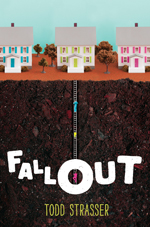
Todd Strasser has been on the children’s and YA literature scene for more than 30 years. His latest YA book Fallout (Candlewick, 2013) has received rave reviews from many outlets, including The Wall Street Journal. School Library Journal calls it “a well-written, compelling story with an interesting twist on how history might have turned out.” Publisher Candlewick has even developed a discussion guide for the book that has direct correlations to the Common Core. We caught up with Strasser to chat about the book, his distinguished career, and his latest project.
toddstrasser  Always an Original: SLJ Talks to Fallout Author Todd Strasser
 
Can you tell us more about your latest book, Fallout?
The book is part memoir and part speculative fiction, rooted in my experience as a twelve-year-old boy living through the Cuban Missile Crisis of 1962, when our family was the only one in town with a bomb shelter. Thus, I not only worried along with everyone else in our country about the very real possibility of a nuclear World War III, but I worried about trying to survive in our shelter as well.
Many of my anxieties concerned the possibility that a war might start while my father was off at work in New York City, and therefore too far away to get home. In that case: Would there be time for me to run home from school before the bombs fell? And since everyone in town knew we had a bomb shelter, would others get there first and demand to be allowed in? What if my mother, brother, and I got inside and our neighbors came and wanted us to let them in?
 
How does it feel writing a book that has a historical setting in which you actual lived?
It certainly stirs up long dormant memories and emotions—and it’s a bit of a reality check. When I revisited the bomb shelter 50 years later, it was a lot smaller than I remembered.
 
What are your memories of 1962?
It was a transformational year in terms of my awareness of the world. Before then, my world view was mostly school and my small neighborhood and friends. Not only was 1962 the year I became aware of the Cold War and the idea that a country thousands of miles away wanted (allegedly) to destroy us, but also that here in the US some people were willing to resort to violence to stop a black man, James Meredith, from enrolling at the University of Mississippi.

You have been writing for a long time. Have you seen many changes in what kids want to read and how books are published?
Fallout is actually my 100th book-length work of original fiction. My first novel, Angel Dust Blues, was published in 1979. It’s about a young man growing up on Long Island who’s arrested for selling marijuana and, like Fallout, is considerably more autobiographical than most of my books.
I came along in the valley between two mountains of series. You might call the first [mountain] “Mt. Stratemeyer,” after Edward Stratemeyer, the creator of Nancy Drew, the Hardy Boys, Tom Swift, and the Bobbsey Twins. The second [mountain] is more like a mountain range; some of the peaks might be called “Mt. Pascal,” “Mt. Martin,” and “Mt. Stine” [and] the tallest, certainly, being “Mt. Rowling.” But I was schooled in the valley of the one-off problem novel. There were hardly any series coming out at that time. And as far as how books are being published? The e-book, of course, which is a blessing for those of us with long lists of out-of-print books.

You have been nominated several times for the Edgar Award.  Are there a certain techniques to writing a good mystery?
Here are some that I’ve gleaned over the years: 1) Be stingy with information. 2) Create as many viable red herrings as possible. 3) At some point, dismiss suspicion of the main culprit.

One of your pastimes is surfing, and you came to it in your fifties.  Can you tell us more about how that happened?
FALLOUT COVER075 398x600 Always an Original: SLJ Talks to Fallout Author Todd Strasser
I’ve always been a water rat, and had always wanted to surf. My daughter and I went to Hawaii the summer after she graduated from high school and saw lots of “Learn to Surf” signs, so we tried it and loved it.

What book would we find on your nightstand?
The Son, by Philip Meyer. An extraordinary story extraordinarily researched.

As an author, how are you using social media?
I’m trying. I’m really trying! I am on Facebook, and have recently been posting photos and stories from the 1960s. On Twitter (@ToddStrasser) I have changed my photo to one that includes the Fallout cover, and I also have been tweeting about topics from the 1960s.

On what are you currently working?
A sci-fi adventure about life after the destruction of Earth’s environment. Working title: Moby Dick in Space.

Wednesday, September 11, 2013

FALLOUT and Todd Featured in Publisher's Weekly

Q & A with Todd Strasser


Photo: Hollis Rafkin-Sax

Bullying, school shootings, and homelessness are some of the weightier topics Todd Strasser has tackled in his novels, but he’s also dabbled in more lighthearted fare, including his Help! I’m Trapped… series for middle-grade readers. The author drew from his own childhood to write Fallout, which Candlewick will publish September 10. The book marks a significant milestone for the author, as it is his 100th original work of fiction (his oeuvre also includes a number of novelizations). In the novel, set on Strasser’s Long Island, N.Y., childhood turf, Scott’s father builds the only bomb shelter in the neighborhood as the Cold War heats up in 1962. Strasser’s father did the same, but happily the family never had to take put the shelter to use. Scott’s family isn’t so lucky.


Obviously your father’s building of a backyard bomb shelter created an indelible memory. How did you come to write a novel based on that incident?
For many years, when I thought about what I wanted to write about, I took a look at what was going on in the present and took a look ahead to the future, but when I got close to turning 60, I started to look back. And the first thing I saw was this incredible experience of my father building a bomb shelter in case of nuclear war. The unintended consequence of that bomb shelter was that I was filled with anxiety about a nuclear war. What if I was in school when this happened? Would they let me run out of school to try to get home to my bomb shelter? This novel actually began when I was 12 years old, lying in bed at night wondering what I would do.
In 1962, was having a personal bomb shelter a rarity?
I do know that we were the only ones in our neighborhood – we lived in Roslyn Heights – who had a bomb shelter. I was known as the kid with the bomb shelter, and kids would tease me and ask if I’d let them in when the time came. I didn’t know it at the time, but after doing a lot of research for the book I realize there was a tremendous amount of publicity surrounding bomb shelters. There was a mass drive to build them in public places, and civil defense agencies put up those little black and yellow signs everywhere indicating underground shelters.


Would you say that this is your most personal novel yet?
Yes, it’s very much based on my own life as a boy, and much more autobiographical than most of my earlier books. Almost all of the characters are conglomerations of people I knew – kids I played with on my street, neighbors, and teachers – though no one character is exactly a real person.
Fortunately, Fallout isn’t an accurate portrayal of how the Cold War played out. What do you hope readers will take from the novel?
People who have written about the novel seem to be focusing on the idea of the Cuban Missile Crisis and these people stuck in this bomb shelter together. But to me, the book is about a young man’s growing awareness of the world around him, and the loss of innocence. Here Scott had this world of going to school and playing with friends on the block, and suddenly forces from thousands of miles away want to destroy him. This is really about a boy who had to grow up very quickly.
And I also bring in the Civil Rights Movement, because that same month in which the book is set, October 1962, there was a riot at the University of Mississippi when James Meredith became the first black student to attend the school. The other thing I wanted to include was the theme of the objectification of women. Scott’s friend Ronnie, who is fixated on women’s breasts – a condition at least partly fostered by the Playboy magazines his father leaves around the house – is constantly badgering Scott to share this fascination. But in the squalid conditions of the shelter, where he and Scott actually confront adult human nakedness for the first time, the mystique is dispelled by the reality that flesh is merely flesh.
Fast forward from 1962 – how did you discover you wanted to be a writer?
When I was in college in the early 1970s – first at NYU and then at Beloit, since I was on the six-year-plan – I had an opportunity to do an independent writing project for a semester. So I began what eventually became Angel Dust Blues, my first novel. When I graduated, there didn’t seem to be many “Help Wanted: Novelists” ads in the newspaper. So I went into journalism, which I think was a very beneficial thing for me.
How so?
Well, I learned a lot about research, and I do a lot of research for my books, so that was helpful. But journalism was limiting – you have to tell the truth and you can’t have happy endings. After I left journalism I spent a little time in advertising, and that was a disaster. All the while, I was writing short stories songs, poems, jokes – anything. I sold a piece of fiction to the New Yorker over the transom. Next thing I knew I had an agent, and Putnam published Angel Dust Blues in 1979.
And is it true that you were also trying your hand at some less conventional writing around that same time?
Yes! In 1978, a close friend and I began talking about how feeble the sayings in fortune cookies were. I’d just sold Angel Dust Blues, and had gotten a $1,500 payment for signing the contract. I’d hoped to use the money to start some sort of business that would provide income to live on while also providing more time to write than a regular nine-to-five job would. So my friend and I discussed selling specialized fortune cookies for niche high-income groups. Something like “No one will die on your operating table today” for doctors, “The jury will find your client innocent” for lawyers, and “There’s a hole-in-one in your future” for golfers.
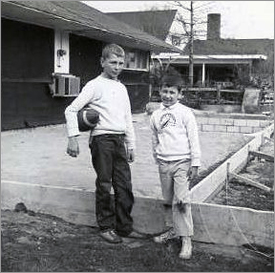
Todd Strasser (l.) and his brother, Leigh, stand by the underground bomb shelter their father built in 1962.
So you ran with that idea?
Not exactly. One night at a party, I was trying to impress a young woman with my entrepreneurial prowess when she mentioned a different kind of fortune cookie that she’d just encountered at an East Side restaurant – let’s call them “grown up” fortune cookies. So we founded Dr. Wing Tip Shoo’s fortune cookies, with sayings like, “When in Rome, ask for Florence,” “Women who sleep with judge get honorable discharge,” and “Clairvoyant contortionist is one who can see her own end” – my personal favorite.
Did they catch on?
They were an immediate hit, and it wasn’t long before novelty representatives were selling them all over the U.S. The income supported my writing “habit” for the next 12 years, at which point I was doing well enough as a writer, and from school visits, to leave the cookies behind.
After Fallout, what’s next on your fiction agenda?
I have a YA novel coming out in January from Simon & Schuster. It’s called No Place and it’s about Dan, a boy whose family loses their home and has to move to a tent city. Dan was vaguely aware that things like that happened, but not to families like theirs. And I’ve signed a contract with Candlewick for another book, whose working title is Moby Dick in Space. I’ve done adventure and sci fi-ish books before, but this one is a bit different. It’s about the destruction of the environment on Earth and a number of other things. The problem is it doesn’t seem to be ending – it keeps going and going and going! I keep thinking this thing has to end but it seems to be endless. It’s an unusual experience for me.
Your novels span genres and age levels – is there one fictional space you feel most comfortable in?
I seem to bounce around, sort of at my whim. If I’ve worked on a realistic novel, I might want to do something kind of light and funny next. And I seem to be able to move back and forth pretty comfortably between middle grade and YA, depending on whatever the next idea is. I started writing middle grade when my kids, who are now 25 and 29, were middle graders themselves. Before that I did mostly YA, and now that my kids are older I’m writing more YA stuff again. But with Fallout, I honestly wasn’t targeting a specific age group at all. I was writing from the heart, and wanted to be as honest as I could possibly be. I truly wasn’t certain what audience it would be for – all I knew is that I wanted to write it.
And is it gratifying to have your 100th original novel published?
It’s funny. Since writing truly is my way of life, getting to a certain number of books doesn’t necessarily mean all that much to me. I plan to keep on doing what I’ve been doing. And who knows? Maybe I’ll find that the first 99 books were just practice! I do feel that it’s very nice that the 100th book happens to be Fallout, since this is such a special book to me.

Sunday, September 8, 2013

It Came Out of the Blue, and I'm Floored

  A Review of Fallout from the Wall Street Journal

It is all too easy, half a century on, to regard the coruscating terror of ordinary Americans during the Cuban Missile Crisis as a dry historical fact rather than a traumatic lived experience. The novelist Todd Strasser, who was a boy at the time, and whose family preparations for nuclear war included building a bomb shelter under their suburban ranch house, has evidently not forgotten the intensity of 1962. Memory here has given rise to a gripping and superbly constructed novel for sophisticated young readers ages 10 and older. In "Fallout" (Candlewick, 258 pages, $16.99), however, the Russians really do drop the bomb, and when the sirens wail, Scott Porter and his parents and little brother, rushing to their homemade bunker, are almost overwhelmed by neighbors frantic to gain refuge in the area's only fallout shelter.


There's not a word out of place in this evocative book, which toggles between the ever-more-dire predicament of the people in the overfilled bunker and the placid neighborhood during the weeks before the crisis. Mr. Strasser's skill at ratcheting up the tension is, if anything, exceeded by his ability to conjure midcentury ways of thinking—and a vanished culture in which aspirational fathers drank Dubonnet, beatniks were a present-tense curiosity, and children were amazed at the very idea of homosexuality.

Friday, August 16, 2013

The Height of the Cold War

It was a frightening time for everyone, and especially for one 12-year-old boy on Long Island.

Monday, August 12, 2013

FALLOUT Earns Starred Review From Publisher's Weekly

Strasser (Kill You Last) brings readers to the 1960s Long Island of his youth, with one crucial difference: in this story, the Cuban Missile Crisis leads Russia to bomb the U.S. The plot alternates between two threads set before and after the bomb drops; in the immediate aftermath, 11-year-old Scott, his family, and a handful of neighbors endure the increasingly difficult conditions in the subterranean bomb shelter Scott’s father built, waiting for radiation levels to fall. The format allows Strasser to have the best of both worlds. In the “before” chapters, he presents a vision of life during the Cold War that feels ripped from personal memory as Scott grows aware of racial prejudice, the prevailing “us vs. them” mentality toward Russia, and his own nascent sexuality (“You want to die without ever seeing a breast?” Scott’s snide friend Ronnie asks). Meanwhile, the “after” chapters are claustrophobic, heartbreaking, and at times ugly as civility breaks down among the few adult and children survivors. An eye-opening “what if” scenario about the human response to disaster. Ages 10–up. Agent: Stephen Barbara, Foundry Literary + Media. (Sept.)


http://www.publishersweekly.com/978-0-7636-5534-1